- Positioning starts with your best-fit customers.
- Your real competitors include spreadsheets, agencies, and doing nothing.
- Use customers' own words to write your positioning statement.
- Test it with real buyers before rewriting your website.
TLDR: Positioning defines who your product is for, what problem it solves, and why it’s the best choice for that customer. Strong positioning starts with your best-fit customers, names the alternatives they consider, and highlights the value only you deliver. It shapes your website, messaging, pricing, and sales conversations.
If prospects keep asking “so what do you do, exactly?” or you're spending all your time marketing and selling to everyone then you likely have a positioning problem. Positioning decides who you sell to, who you compete with, and why buyers should pick you. Your website, pitch deck, and ads all sit on top of it.
The good news: you can fix it without a rebrand, a big agency, or a three-day offsite. This guide walks you through defining your positioning, testing it, and knowing when to change it.
What is positioning?
Positioning is the choice of who you’re for, what you’re compared to, and why you’re the obvious pick for that buyer. Positioning includes these four aspects:
- Target customer: who gets the most value from you. What do they look like, what are their buying habits, what are their pain points?
- Market category: the box buyers put you in. What is your core function?
- Competitive alternatives: what buyers would use if you didn’t exist. Who are you competiting against? What are their other options? How are you similar to them?
- Unique value: what you deliver that those alternatives can’t. Why are you different? What can you offer that your competitors can't?
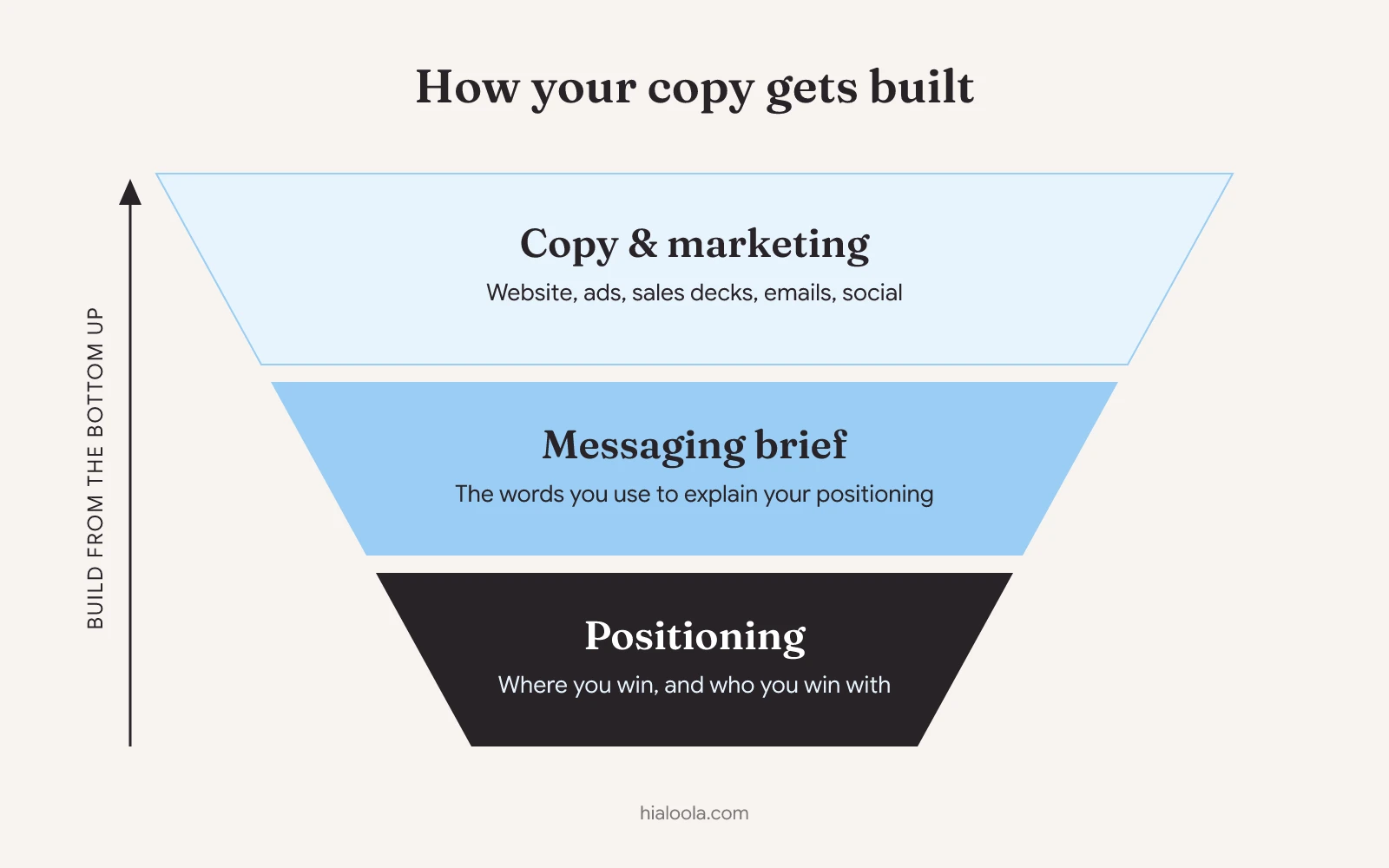
Positioning is your wedge in the door. Then, the messaging brief you create around the wedge puts it into words. That's your foundation. Every tagline, web page, and sales pitch is built from the brief.
If you don’t choose your positioning, buyers will choose it for you, usually by comparing you to whatever they already know.
Why does positioning matter for early-stage businesses?
Early-stage companies have small budgets and little name recognition. Clear positioning makes each dollar and each sales call go further, because prospects can tell within seconds whether you’re for them.
It also matters more as products get easier to build. Supabase’s 2026 State of Startups survey found 62% of startups have more than half their codebase written by AI, and the report names fear of AI competition among founders’ new pressures. When a rival can ship a similar feature set in weeks, a sharp answer to “why you, for whom?” becomes your edge.
And the cost of getting the market wrong is high. CB Insights’ 2026 analysis of 431 venture-backed shutdowns found 43% of companies with a known cause struggled with poor product-market fit. Many of them built something real but never found the buyers who needed it most.
How do you define your positioning?
Work through these four steps in order. Each one builds on the last, so resist the urge to jump straight to the fun part (naming your category).
1. Identify your best-fit customers
Look at your happiest customers: the ones who closed fastest, stayed longest, and refer others. What do they share? Industry, company size, role, and the trigger that sent them looking. If you don’t have customers yet, use the prospects who showed the most urgency on discovery calls.
2. List the real alternatives
Ask those customers what they would use if you didn’t exist. The answer is often a spreadsheet, an agency, a new hire, or doing nothing at all. These are the options you actually compete against, so your messaging needs to address them.
Customer interview questions (copy and paste):
1. What was happening in your business when you started looking for a solution like ours?
2. What else did you consider, including doing nothing?
3. Why did you pick us over those options?
4. If we disappeared tomorrow, what would you use instead?
5. How would you describe what we do to a peer?
3. Name your unique capabilities
List what you do that those alternatives can’t. Then translate each capability into the value it creates for the customer, such as hours saved, revenue gained, or risk reduced. Buyers care about the outcome, so lead with it.
4. Choose your market category
Pick a category that makes your value obvious. A familiar category helps buyers understand you fast. Creating a new category takes more education and budget, which is a heavy lift for an early-stage team.
Positioning statement (copy and paste):
For [best-fit customer] who [trigger or problem],
[Product] is a [market category] that [key value or outcome].
Unlike [main alternative], we [unique capability that proves it].
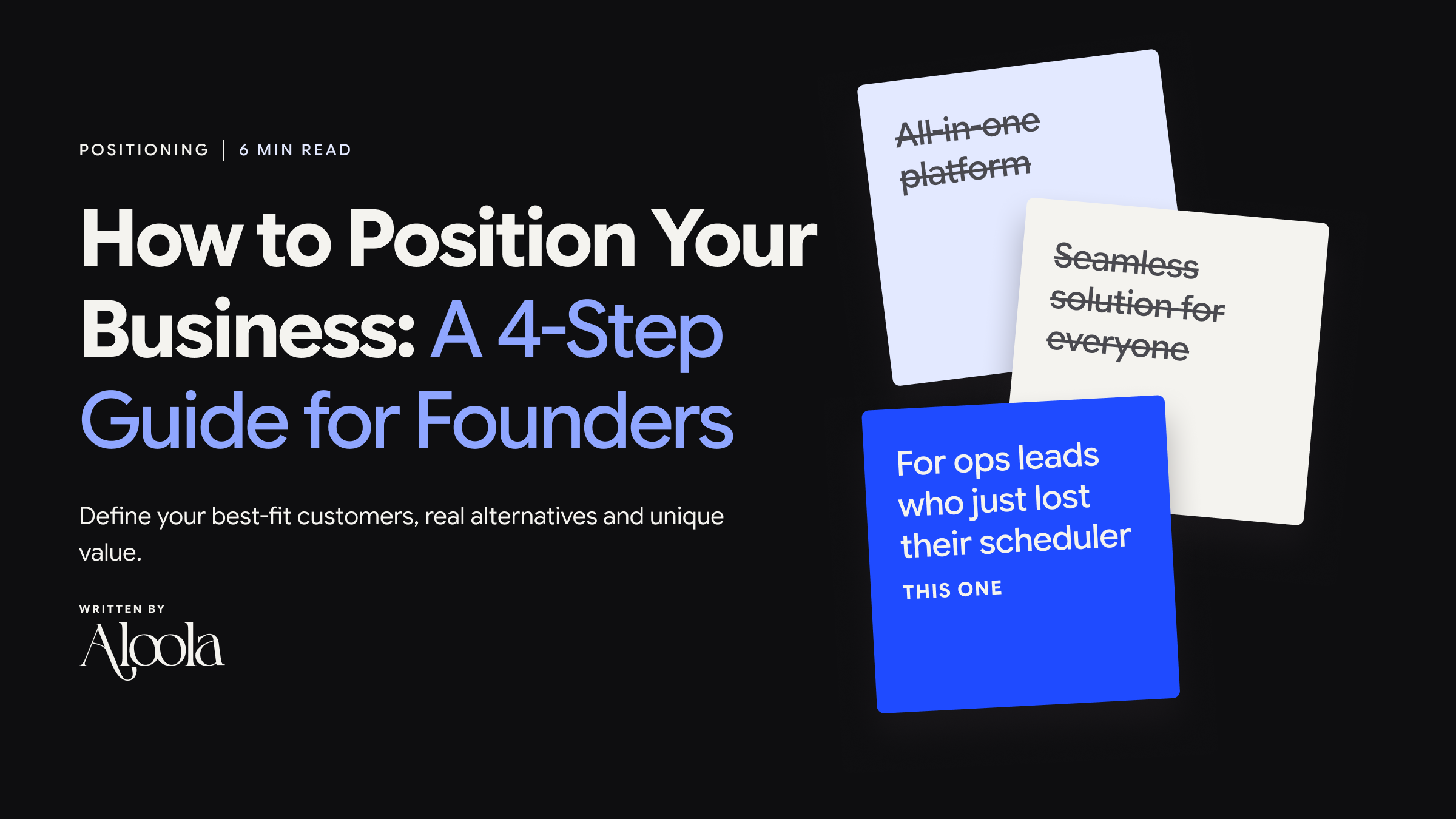
Pro tip: Fill this in using your customers’ exact words from the interviews. If you catch yourself writing “all-in-one platform” or “seamless,” go back to the transcripts.
How do you test your positioning?
A positioning statement is a hypothesis until buyers react to it. Put it to work in real settings: sales calls, your homepage headline, outreach messages, and LinkedIn posts. Then watch for these signals:
- Prospects repeat your words back to you
- Sales calls get shorter and more focused
- The right people reply to outreach
- Fewer leads turn out to be a poor fit
If confusion continues, revisit your target customer or category choice before rewriting copy.
Five-second test: Show your homepage to someone in your target market for five seconds, close it, then ask:
1. What does this company do?
2. Who is it for?
3. Why would someone pick it over the alternatives?
Pro tip: Run the test with five people. If three or more can’t answer question two, your target customer isn’t coming through yet.
When should you reposition?
Positioning isn’t a tattoo. Revisit it when:
- You ship a major product change
- A new segment buys faster than your original target
- Win rates drop for several quarters in a row
- Your category gets crowded with similar offers
Repositioning can feel like admitting you got it wrong. Usually it just means you learned something about your market.
Pro tip: Before you reposition, pull your last 10 closed-won and 10 closed-lost deals. Look for the pattern in who bought and why. That data will tell you more than any brainstorm.
Can you position a business before you have customers?
Yes. Use your most engaged prospects and discovery calls as your evidence, then refine once paying customers give you real data.
Pro tip: Save every phrase prospects use to describe their problem in one shared doc. It becomes your best source for homepage headlines, ad copy, and sales emails.
Want help finding where you win? Aloola builds positioning and messaging for founder-led companies in focused, fixed-scope sprints. Book a call.