
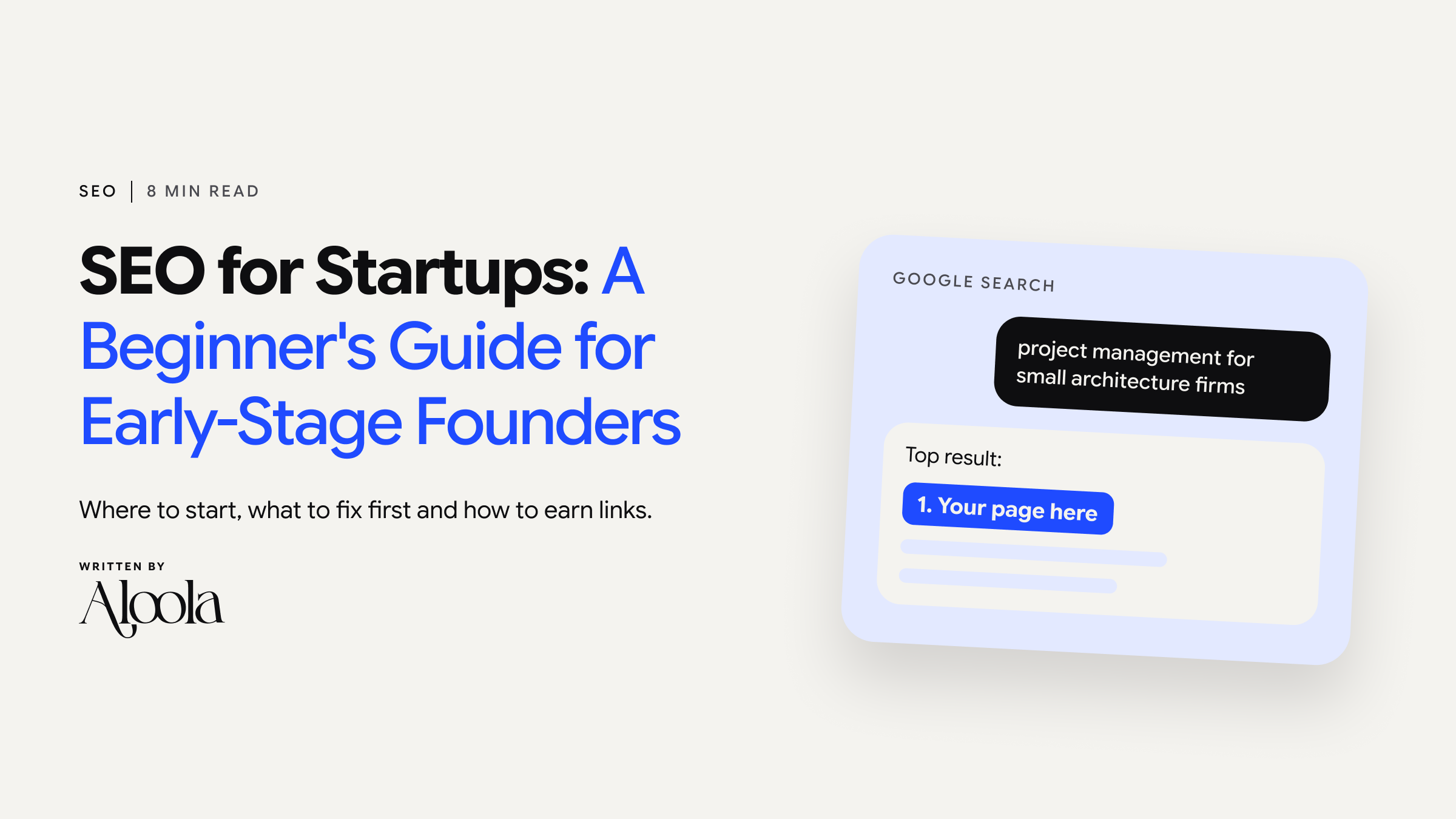
- Target specific, low-competition searches your buyers already make instead of broad head terms.
- Expect SEO to take months, and judge it in 90-day blocks: impressions, then clicks, then signups.
- Optimize pages closest to revenue first: homepage, product, comparison and pricing pages.
- Set up the technical basics once, then focus on useful content and a handful of relevant links.
TLDR: SEO for startups means picking a small set of specific, low-competition searches your buyers already make, then building a few genuinely useful pages that answer them. Set up the technical basics once, optimize your money pages first, publish on a steady schedule and earn a handful of real links. Expect results to take months, and treat SEO as a channel that compounds.
You shipped the site. You wrote a few blog posts. You open Google Search Console a month later and see 14 impressions, 11 of which were you checking whether the site was live. Welcome to SEO for startups.
The good news: early-stage companies can win at search, but rarely by copying what big brands do. You win by choosing searches that are too small or too specific for bigger players to bother with, and by answering them better than anyone else. This guide covers when SEO is worth it, how long it takes, what to fix first and how to get your first links, with a checklist and a content brief you can use today.
Is SEO worth it for startups?
Yes, if you go in with clear eyes. Most pages on the internet get nothing from search. Ahrefs analyzed about 14 billion pages and found that 96.55% of all pages in its index get zero traffic from Google. The top reasons were no search demand for the topic, no backlinks and a mismatch with what searchers actually wanted.
Search is also changing. A Pew Research Center analysis of 900 U.S. adults found that Google users clicked a traditional result in 8% of visits when an AI summary appeared, compared with 15% when it didn't. Broad "what is" questions are getting answered on the results page itself.
So SEO is worth it when:
- Your buyers search for the problem you solve, even in small numbers
- You can commit to publishing and improving pages for at least six months
- You target specific, high-intent searches instead of broad definitions
If your buyers don't search for your category yet, put SEO second and lead with outbound, partnerships or community until they do.
How long does SEO for startups take?
Longer than you want. In Ahrefs' study of ranking speed, only 1.74% of newly published pages reached the top 10 within a year, and the average page ranking first was five years old. A separate sample of English pages put the figure at 6.11%, which is still a small slice.
Google says much the same in its own guide. From the Google Search Central SEO Starter Guide:
"Some changes might take effect in a few hours, others could take several months."
That doesn't mean waiting a year to see anything. Low-competition, long-tail pages can start showing up within weeks. The bigger, more competitive terms take longer and usually need links.
Pro tip: Judge SEO in 90-day blocks. In the first block, track impressions in Google Search Console. In the second, track clicks. By the third, look at signups or demo requests from organic search. Impressions rising first is a good sign, even before clicks catch up.
How do you find keywords your startup can actually rank for?
Go small and specific. Ahrefs found that keywords with fewer than 10 searches per month make up almost 93% of its U.S. keyword database. That long tail is where startups win, because big sites rarely bother with it and the people searching tend to know exactly what they want.
Compare these two:
- "Project management software" is broad, crowded and full of browsers
- "Project management for small architecture firms" is narrow, quieter and full of buyers
Start with your customers. Listen to sales calls, read support tickets and note the exact words people use to describe their problem. Then check those phrases in a keyword tool or simply type them into Google and look at what ranks. If the top results are giant brands with thousands of links, pick a more specific angle.
Starter keyword list (copy and paste):
Problem searches: how to [solve problem] for [customer type]
Comparison searches: [your category] vs [alternative]
Alternative searches: [competitor] alternatives for [customer type]
Use-case searches: [your category] for [industry or role]
Cost searches: how much does [solution] cost
Template searches: [task] template or checklist
For each one, note: monthly searches, who ranks now, and whether a buyer or a browser is searching.
What pages should a startup optimize first?
Start with the pages closest to revenue. Rankings near the top matter a lot. Backlinko's analysis of 4 million Google results found that the #1 organic result has an average click-through rate of 27.6%, and only 0.63% of searchers clicked anything on page two.
That means it pays to aim a few strong pages at specific searches before spreading thin. In order:
- Homepage: make sure it says plainly what you do and for whom, using words customers search.
- Product or service pages: one page per core use case or customer type.
- Comparison and alternatives pages: honest "us vs them" pages convert well because the searcher is already shopping.
- Pricing page: people search for cost. Even a "starts at" range helps.
- Blog posts: answer the problem and how-to searches from your keyword list.
Pro tip: Give every important page one main search target and write its title tag around it. Two pages chasing the same phrase usually split the results and neither ranks well.
What SEO basics should a startup set up on day one?
Technical SEO sounds intimidating, but for a small site the essentials take an afternoon. Google sums up the whole discipline in one line in its SEO Starter Guide: "SEO is about helping search engines understand your content."
Day-one SEO checklist (copy and paste):
[ ] Verify the site in Google Search Console and submit your sitemap
[ ] Check that no important page is set to noindex
[ ] Write a unique title tag (under about 60 characters) for every page
[ ] Write a unique meta description (about 150 characters) for every page
[ ] Use one H1 per page that matches what the page is about
[ ] Keep URLs short and readable, like /pricing or /for-agencies
[ ] Add descriptive alt text to meaningful images
[ ] Compress images and test mobile speed in PageSpeed Insights
[ ] Link related pages to each other with clear anchor text
[ ] Set up redirects for any old URLs you changed
Most website builders, including Webflow, handle sitemaps and clean code for you. Your job is mostly the words: titles, headings and page copy.
How do you write content that ranks?
Write for the person searching, then make it easy for Google to follow. Google's guidance is direct about this: "Creating content that people find compelling and useful will likely influence your website's presence in search results" (Google Search Central).
In practice, pages that rank tend to:
- Answer the main question in the first few lines
- Use headings phrased the way people search
- Include real examples, numbers and experience only you have
- Match the format searchers expect, like a list, a guide or a comparison
- Stay current, with updates when facts change
Before you write, search your target phrase and skim the top five results. Note what they all cover and what they all miss. Your page should cover the basics and add the thing they're missing.
SEO content brief (copy and paste):
Target search: [phrase]
Who is searching: [role, stage, situation]
What they want to walk away with: [answer, template, decision]
Format that ranks now: [guide, list, comparison, tool]
What the top 5 results cover: [common points]
What they miss that we know: [our angle, data or experience]
H2s (as questions): 1. [ ] 2. [ ] 3. [ ] 4. [ ]
Proof to include: [stats with links, customer examples]
Call to action: [next step for the reader]
Internal links: [2 to 3 related pages on our site]
How do you get backlinks as a new startup?
Links from other sites still matter. In Ahrefs' traffic study, a lack of backlinks was one of the main reasons pages got no search traffic, and pages with more linking domains tended to get more traffic. You don't need hundreds. A handful of relevant ones can move a young site.
Realistic ways for an early-stage company to earn links:
- Partners and customers: ask tools you integrate with and happy customers to list you on partner or case study pages.
- Founder expertise: answer journalist and podcast requests in your niche, and guest on shows your buyers listen to.
- Original data: publish a small survey or anonymized product data. People link to numbers.
- Useful free resources: templates, calculators and checklists get bookmarked and cited.
- Startup directories and communities: relevant, reputable listings are worth claiming once.
Pro tip: Skip paid link packages and link swaps. They waste money at best and can hurt your rankings at worst. One link from a respected site in your industry is worth more than fifty from sites nobody reads.
What SEO mistakes do startups make?
We see the same ones on early-stage sites again and again:
- Chasing big head terms. Ranking for "CRM" as a two-person team isn't a plan.
- Publishing and forgetting. Pages that never get updated slowly slide down.
- Blogging before fixing core pages. Your product and pricing pages bring buyers. Fix them first.
- Writing for algorithms. Keyword-stuffed copy reads badly and converts worse.
- Redesigning without redirects. Changing URLs without redirects can wipe out rankings you earned.
- Quitting at month three. SEO compounds, and most founders stop right before it starts working.
Pro tip: Every quarter, open Search Console and sort pages by impressions. Find pages ranking in positions 5 to 15 and improve those first. Moving a page from position 8 to position 3 is usually easier than ranking a brand-new page.
Frequently asked questions
Should a startup do SEO before product-market fit?
Do the basics: a clear homepage, solid title tags and Search Console. Hold off on heavy content production until you know who your best customer is, because your keyword list depends on it.
Can I do SEO myself or should I hire someone?
Most founders can handle the basics and the first 10 to 20 pages themselves. Bring in help when you have a clear keyword strategy and need consistent publishing or technical work at scale.
How many blog posts does a startup need?
There's no magic number. Ten strong pages aimed at specific buyer searches beat fifty thin ones. Publish on a pace you can keep, like two posts a month.
Does SEO still matter with AI search?
Yes. Clear, well-structured pages that answer real questions still earn clicks from search, and the same qualities help AI tools understand and reference your site.
Pro tip: Add a short FAQ section to your key pages using real questions from sales calls. It helps visitors, gives search engines clear answers to match and often reduces the same questions in your inbox.
Want a website that's built to be found? Aloola builds positioning, messaging and websites for founder-led companies in focused, fixed-scope sprints. Book a call.