
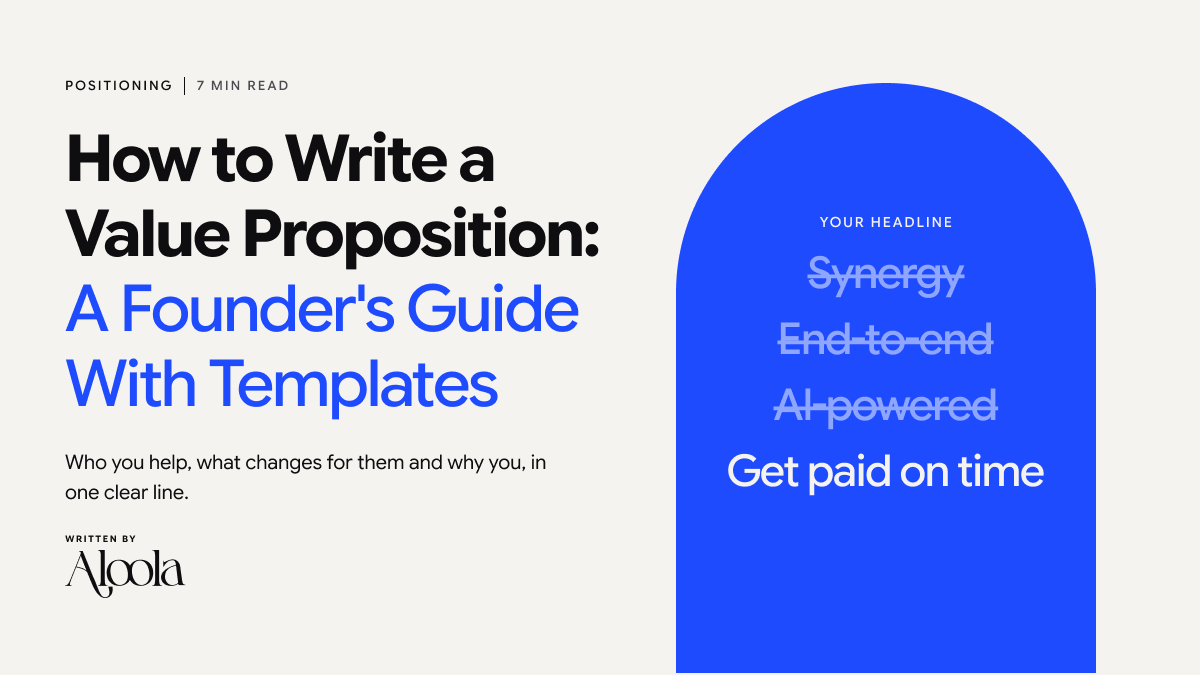
- A value proposition explains who you help, the result they get and why they should choose you over the alternatives.
- Visitors often leave a page in 10 to 20 seconds, so your main benefit has to land in one short headline.
- Write it in your customers' own words, lead with one outcome and back it with a subhead and real proof.
- Test drafts on people who match your customer before you put them on your homepage.
TLDR: To write a value proposition, name who you help, the problem they have, the result you deliver and the reason they should believe you. Write it in your customers' words, keep the headline to one short sentence and back it with a subhead and proof. Then test it on real people from your market before you put it on your homepage.
You know exactly what your product does. You could talk about it for an hour. Then someone asks "So what is it?" at a networking event and you hear yourself say "It's kind of a platform that helps teams, um, do things better." We've all been there.
A clear value proposition fixes that moment, and it fixes your homepage, your pitch and your sales emails at the same time. This guide covers what a value proposition is, what makes one work, how to write a value proposition in five steps, formulas you can copy and how to test it before you commit.
What is a value proposition?
A value proposition is a short statement that explains who you help, what result they get and why they should pick you over the alternatives. It's the answer to the question every visitor silently asks: "Why should I care?"
Peep Laja, founder of CXL, puts it simply in CXL's guide to value propositions:
"A value proposition is a promise of value to be delivered."
A full value proposition usually has three parts:
- Headline: the main benefit in one short sentence
- Subhead: one or two sentences on what you offer, for whom and how it works
- Proof: bullets, numbers, logos or testimonials that make the promise believable
It's different from a slogan or a mission statement. "Just do it" is a slogan. Your value proposition is the plain-English explanation a buyer needs before they'll take the next step.
Why does your value proposition matter so much?
Because people decide fast. Jakob Nielsen's analysis of page visit data at Nielsen Norman Group found that users often leave web pages in 10 to 20 seconds. His advice from that study:
"To gain several minutes of user attention, you must clearly communicate your value proposition within 10 seconds."
A fuzzy value proposition also hides a bigger problem. When CB Insights reviewed 101 startup post-mortems, 42% named "no market need" as a reason they failed, the most common answer in the report. If you can't say clearly who needs your product and why, that's worth treating as an early warning sign.
Writing your value proposition forces you to answer those questions on paper, before you spend money on a website, ads or a sales hire.
What makes a good value proposition?
Good value propositions share a few traits. They are:
- Specific: they name a customer and a result. "For independent bookkeepers" beats "for businesses."
- Outcome-led: they talk about what changes for the customer, with features as supporting detail.
- Different: they say why you, compared with the real alternatives, including spreadsheets, an intern or doing nothing.
- Believable: they come with proof, and they don't promise what you can't deliver.
- Quick to read: a stranger gets it in one pass, without a glossary.
It also helps to know what kind of value you deliver. Bain & Company researchers identified 30 "elements of value" in four categories: functional, emotional, life changing and social impact. Saving time and reducing cost are functional. Reducing anxiety is emotional. Most early-stage products lead with one functional element and back it with an emotional one.
Pro tip: Pick one main benefit for your headline. If you list "faster, cheaper, easier and more secure," readers remember none of them. Put the other benefits in your subhead and bullets.
How to write a value proposition in 5 steps
Block out an hour. You'll need notes from a few customer conversations and a blank document.
1. Name the customer
Write down the specific group you serve best right now. Use a role, an industry or a situation. "Founders" is too broad. "First-time founders raising a pre-seed round" is a customer you can picture.
2. Write the problem in their words
Reread sales call notes, support emails and reviews. Copy the exact phrases people use to describe the pain. Customers rarely say "workflow inefficiency." They say "I spend every Friday chasing invoices."
3. Define the result
What's different after they use you? Be concrete: time saved, revenue gained, a task removed, a worry gone. If you have a real number from customers, use it. If you don't, describe the outcome plainly and skip the made-up percentage.
4. Explain why you
List the alternatives your customer actually considers. Then write the one or two things you do that those options don't. This is your differentiator, and it belongs in the subhead.
5. Add proof
Gather anything that makes the promise believable: customer quotes, logos, a result, a guarantee, years of experience or a demo. Early on, one specific testimonial beats a wall of vague praise.
Value proposition worksheet (copy and paste):
Customer: [specific group]
Their problem, in their words: "[exact phrase from a customer]"
Result they want: [concrete outcome]
Alternatives they consider: [option 1], [option 2], doing nothing
Why us: [1 to 2 differences that matter to them]
Proof: [testimonial, number, logo or guarantee]
Headline draft: [main result] for [customer]
Subhead draft: [what you offer] helps [customer] [result] without [main frustration].
Value proposition formulas you can copy
Formulas won't write your value proposition for you, but they give you a solid first draft fast. Fill in each one, then pick the version that sounds most like something a customer would say.
Value proposition formulas (copy and paste):
1. We help [customer] [achieve result] by [how you do it].
2. [Result] for [customer], without [main frustration].
3. The [category] for [customer] who [specific situation].
4. For [customer] who [need], [product] is a [category] that [key benefit]. Unlike [alternative], we [main difference].
5. Stop [painful task]. Start [desired outcome].
Here's formula 2 in action for a made-up bookkeeping tool:
- Before: "An all-in-one AI-powered financial management platform."
- After: "Get paid on time, without chasing invoices. Automatic reminders for freelancers and small agencies."
The second version names the customer, the result and the frustration it removes. It also uses words a tired freelancer would actually type into Google.
Formula 4 is the long-form positioning statement. Use it internally to align your team, then shorten it for your homepage.
How do you test a value proposition?
You're too close to your own product to judge your copy. Test it on people who match your customer and haven't heard your pitch.
- Five-second test: show your homepage for five seconds, hide it and ask what you do and who it's for.
- Customer read-back: share two or three versions with customers and ask which one describes why they bought.
- Sales call check: say the headline early in a call and watch whether the prospect leans in or asks you to explain.
- Ad or email test: run two headlines in a small paid campaign or a cold email and compare replies or clicks.
Pro tip: If testers describe your product back to you in different words than yours, use their words. That's free copywriting from the people you're trying to reach.
What value proposition mistakes should founders avoid?
We see the same ones across early-stage websites:
- Leading with features. "Real-time sync" means little until you explain what it saves the customer.
- Writing for everyone. A value proposition that fits every company fits none of them well.
- Using jargon. "Leverage," "synergy" and "end-to-end" make readers work harder and trust you less.
- Being clever over clear. Wordplay is fun in a team meeting. Visitors just want to know what you do.
- Promising what you can't prove. "10x your revenue" without evidence makes the rest of your page less believable.
- Never updating it. Your value proposition should sharpen as you learn who your best customers are.
Pro tip: Read your headline out loud and ask, "Could a competitor put this on their site unchanged?" If the answer is yes, it isn't specific enough yet.
Frequently asked questions
How long should a value proposition be?
Keep the headline under about 10 words and the subhead to one or two sentences. Supporting bullets can add detail, but a reader should understand the core idea from the headline alone.
What's the difference between a value proposition and a positioning statement?
A positioning statement is an internal tool that defines your market, customer and difference. Your value proposition is the customer-facing version of that thinking, written to persuade.
Can a startup have more than one value proposition?
Yes. Keep one main value proposition for the company, then tailor versions for each customer segment or product page. They should all point back to the same core promise.
How often should I update my value proposition?
Review it whenever your best customer changes, you launch a major feature or sales calls show confusion. For most early-stage companies, a quick check every quarter is enough.
Pro tip: Save the exact questions prospects ask on sales calls. If the same question comes up three times, your value proposition or subhead should answer it.
Want help nailing your value proposition? Aloola builds positioning, messaging and websites for founder-led companies in focused, fixed-scope sprints. Book a call.