
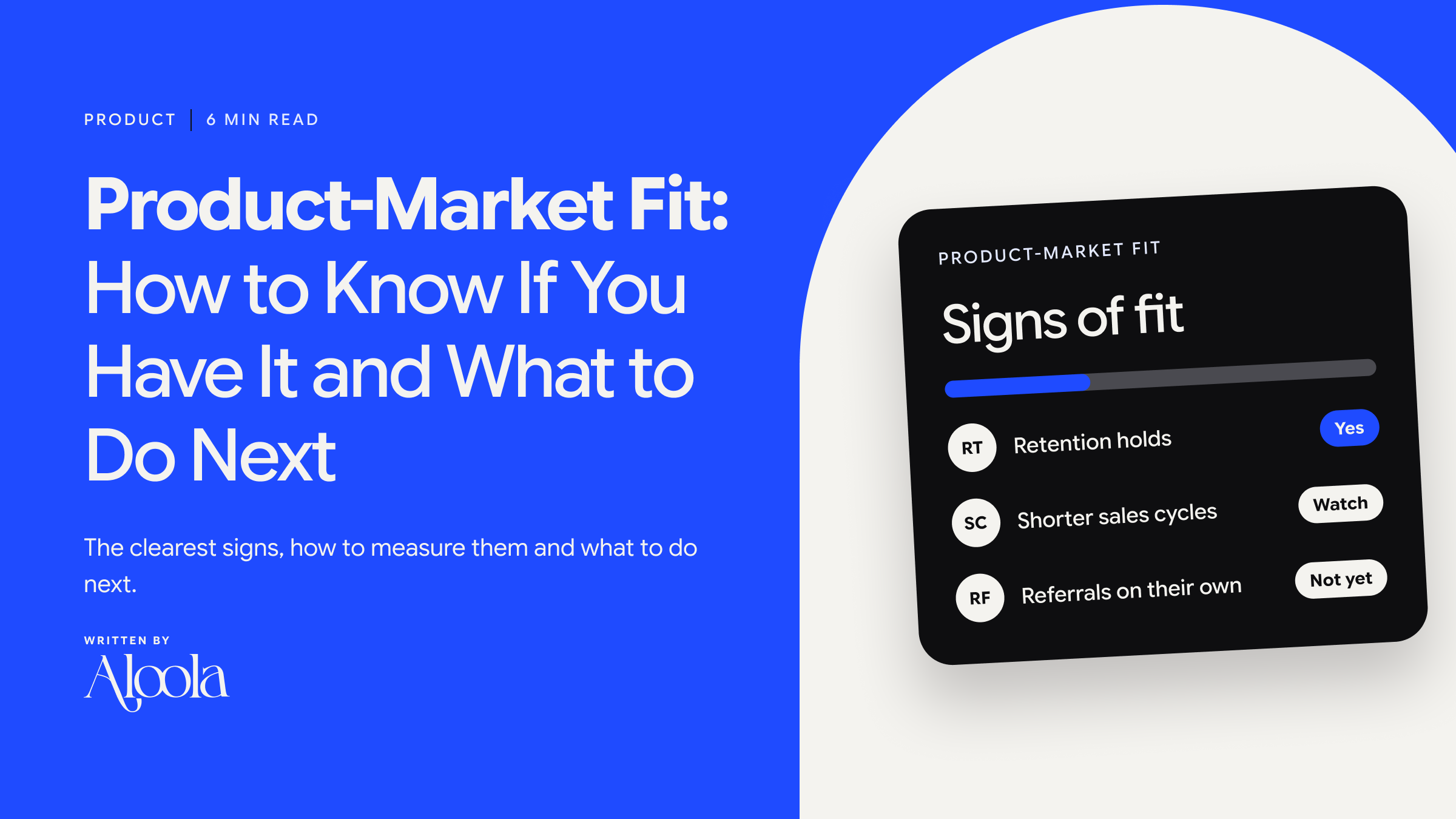
- Product-market fit shows up in behavior: retention, referrals and shorter sales cycles.
- The Sean Ellis survey gives you a score: aim for 40% or more "very disappointed."
- Look at signals by segment, since averages hide the group that's working.
- Narrowing your focus to your biggest fans usually improves fit faster than a rebuild.
TLDR: You likely have product-market fit when customers pull the product from you: they buy without heavy convincing, keep using it, renew, and refer others. The clearest signals are retention that levels off, shorter sales cycles, and word of mouth you didn't pay for. The fastest way to measure it is the Sean Ellis survey, which asks users how disappointed they'd be if your product disappeared.
You launched. A few people bought. Some even said nice things. So why does every sale still feel like pushing a couch up a staircase? That gap between "people like it" and "people can't live without it" is product-market fit, and most founders spend longer looking for it than they expected.
This guide covers how to tell whether you have product-market fit, how to measure it with a simple survey, and what to do if the answer is "not yet."
What is product-market fit?
Product-market fit means a specific group of customers wants your product enough to buy it, keep using it, and tell others about it. Marc Andreessen popularized the term in a 2007 essay, and his definition is still the cleanest one around:
"Product/market fit means being in a good market with a product that can satisfy that market." Marc Andreessen, The Only Thing That Matters
Notice the two halves. A great product in a tiny or uninterested market won't get you there. Neither will a huge market with a product that's just fine. You need both, for one clearly defined group of buyers.
It also matters more than almost anything else you'll work on this year. CB Insights' 2026 analysis of VC-backed shutdowns found poor product-market fit was cited in 43% of failures with a known cause.
What are the signs you have product-market fit?
Andreessen described it as the moment when "the customers are buying the product just as fast as you can make it." You don't need to be drowning in demand to count, but you should see most of these signals together.
Retention holds over time
Customers keep using or paying month after month. On a cohort chart, the retention curve drops at first and then flattens out instead of sliding toward zero.
Sales cycles get shorter
Prospects arrive already understanding the problem. Deals close with fewer calls, fewer "let me check with my team" delays, and less discounting.
Referrals show up on their own
Customers bring you new customers without being asked or paid. Inbound interest grows even when your marketing spend stays flat.
Customers complain when things break
This one surprises people. When your product goes down and the support inbox fills up within minutes, that's a good sign. People only get upset about losing something they rely on.
Pro tip: Look at signals by customer segment, not across your whole base. You might have strong fit with agencies and weak fit with in-house teams. Averages hide the segment that's working.
How do you measure product-market fit?
Gut feel is a terrible measuring stick, because every founder is optimistic about their own product. Use two tools instead: a short survey and a cohort retention chart.
The Sean Ellis survey
Growth advisor Sean Ellis asked users of nearly 100 startups one question: how would you feel if you could no longer use this product? According to First Round Review, companies where fewer than 40% of users answered "very disappointed" generally struggled to grow, while companies with strong traction usually cleared 40%.
Send it to people who have used your product recently and more than once. Brand-new signups haven't formed an opinion yet.
Product-market fit survey (copy and paste):
1. How would you feel if you could no longer use [Product]?
(Very disappointed / Somewhat disappointed / Not disappointed)
2. What type of person do you think would benefit most from [Product]?
3. What is the main benefit you get from [Product]?
4. How can we improve [Product] for you?
These are the four questions Superhuman used to build its own fit process, and the second and third questions are where the gold is. They tell you who your best customers are and what they value in their own words.
Cohort retention curves
Group customers by the month they started, then track what share are still active or paying in each following month. Curves that level off point to fit. Curves that keep falling toward zero point to a problem with the product, the customer, or both.
Pro tip: Aim for at least 40 survey responses before reading much into the score. With 10 responses, two people changing their minds swings your result by 20 points.
What are the signs you don't have it yet?
If several of these sound familiar, you're not there yet. That's normal, and it's fixable.
- Growth depends entirely on outbound effort, and it stalls the week you stop
- Customers churn after the first few months
- Feedback is polite, but nobody urgently needs what you sell
- Every deal requires custom work or a heavy discount
- You struggle to describe who your best customer is
You're also in good company. Wilbur Labs' 2026 survey of 200 US tech founders found 81% said their company pivoted from its original idea at least once, and 54% said the most important lesson from failure was the need to better understand product-market fit.
How do you get closer to product-market fit?
The good news: a narrower focus usually improves fit faster than a rebuild. Superhuman is the best-known example. Its "very disappointed" score started at 22% in 2017. By focusing on the users who loved it most and fixing what held back the users who almost did, the team raised it to 58% over about three quarters, according to First Round Review.
Here's a version of that process sized for a small team:
- Narrow your target. Filter your survey results to the "very disappointed" group. Who are they? Industry, role, company size, the problem that sent them looking. Make that group your focus.
- Learn what your fans love. Read their answers to "what is the main benefit you get?" The words they use should become your homepage headline.
- Fix what's holding back the near-fans. Look at the "somewhat disappointed" users who share that main benefit. Their improvement requests are your roadmap.
- Cut what nobody misses. Features that only serve the "not disappointed" group can wait.
- Re-measure every quarter. Run the survey again and track the score like any other key metric.
Pro tip: Split your roadmap roughly in half. Spend one half doubling down on what fans already love, and the other half on the top requests from near-fans. Ignoring either half slows you down.
Frequently asked questions
What is the Sean Ellis test?
A one-question survey that asks users how they would feel if they could no longer use your product. If 40% or more answer "very disappointed," you likely have product-market fit.
Can you lose product-market fit?
Yes. Markets shift, competitors improve, and customer needs change. Keep running the survey and watching retention after you find fit.
Should you scale marketing before product-market fit?
Usually not. Spending more on ads before people stick around tends to raise acquisition costs without lasting growth. Most founders get more from improving retention first.
How long does it take to find product-market fit?
It varies widely by market and product. Superhuman took roughly three quarters of focused work to move from 22% to 58%, and that was with a dedicated team.
Pro tip: Put your survey score on the same dashboard as revenue. What gets reviewed every month gets improved.
Found your best-fit customers but not sure how to speak to them? Aloola builds positioning and messaging for founder-led companies in focused, fixed-scope sprints. Book a call.